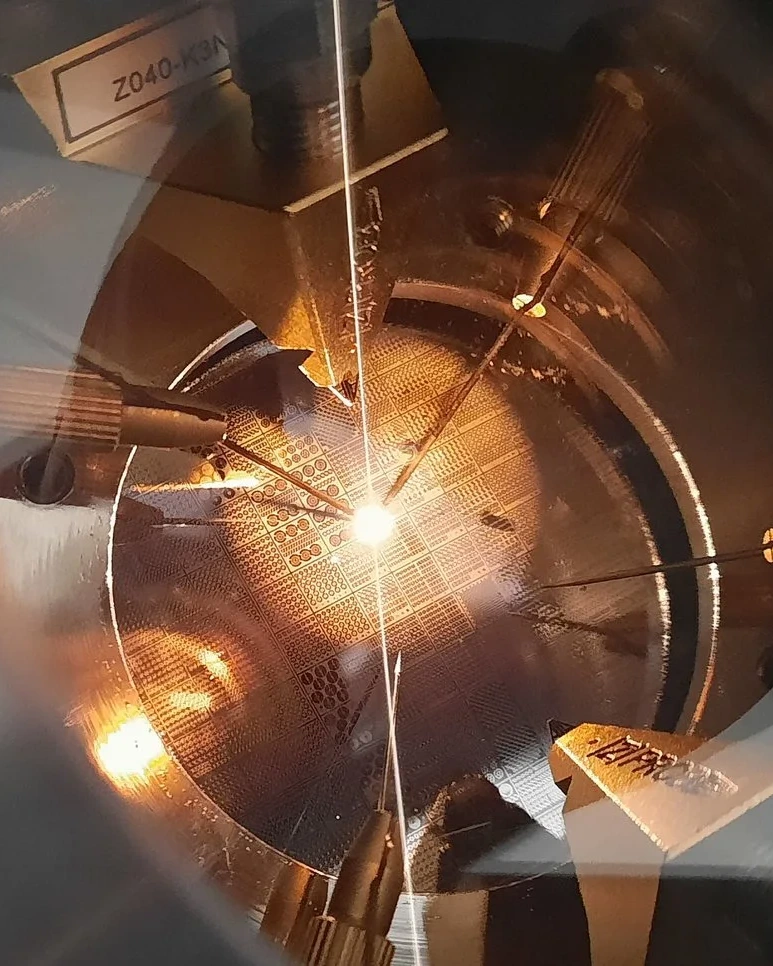
Many molecules have characteristic infrared signatures that can reveal their presence and concentration, from biochemical markers such as lactate to CO₂ in the air. While lab measurements of chemical spectral signatures is standard, bringing this capability into wearables and accessible to the larger public remains challenging. One key missing component is a broadband infrared light source that combines a tiny footprint, low power consumption and a path to affordable, high-volume production.
4K-MEMS, a deep-tech company from Saint-Blaise, Switzerland, has built one. Together with the University of Trento, it has secured a €2.5 million grant from the European Innovation Council’s Transition programme to bring it a big step closer to market.
At Dealflow.eu, we had the pleasure of working with the consortium on the application, and we’re excited to share more about the project and the team behind it.
A star on a chip
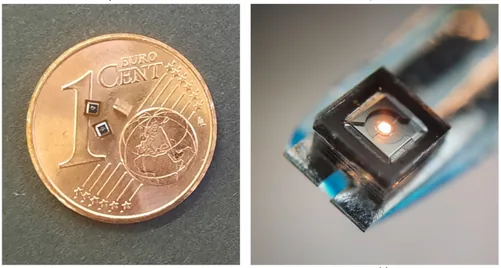
The 4K-MEMS emitter measures just a millimeter across. Inside, a microscopic element is heated, glowing like a tiny star and giving off a broad spectrum of infrared light. The emitter produces a very broad spectrum of infrared light, making it suitable for sensing many different substances, from biochemical markers to gases in the air.
The size reduction is striking, and its impact extends to the entire sensor. The emitter’s tiny footprint and emission properties allow the surrounding optics and sensing system to shrink, while reducing the heat load. This opens the door to embedding infrared sensing in devices and platforms where it previously could not fit. All this can be done at scale using wafer-scale lithographic fabrication, which ensures high uniformity and low unit costs.
BRIGHTIR: from chip to body
In BRIGHTIR, 4K-MEMS and the University of Trento’s Department of Cellular, Computational and Integrative Biology (CIBIO) are putting the emitter to work. The goal is to bring non-invasive biochemical sensing into compact wearable devices, starting with lactate, a key marker of muscle effort, for sport and fitness.
“What excites me most is the prospect of measuring biochemical signals directly, alongside the physiological indicators and model-based estimates used today,” says Dr Matthias Imboden, co-founder and CEO of 4K-MEMS. “This could give people a much clearer picture of how their bodies respond to exercise and recovery.”
The project stems from an EIC Pathfinder project, OMICSENS, entering its final year. “Within OMICSENS, 4K-MEMS advanced miniature broadband infrared emitters and their scalable manufacturing, while our partners at the University of Trento demonstrated biomolecular sensing. BRIGHTIR brings these complementary strengths together around a concrete application.”
With the project now underway, the team’s next steps are to industrialize the emitter technology and validate sensing approaches in biological models and skin phantoms, materials that mimic human skin.
Far beyond wearables
Health monitoring is the first use case, but the same chip can serve many other fields, from CO₂ and air-quality monitoring to in-line material quality control and portable spectrometers. The project also strengthens Europe’s capabilities in infrared sensing. By advancing a compact broadband source designed for scalable manufacturing, BRIGHTIR could expand the options available to manufacturers developing sensing systems for healthcare, agriculture, industry, and environmental monitoring.
Behind the application
EIC Transition funds a demanding step: helping a technology that works in the lab prove itself in the real world, on its way to becoming a product. Great science alone isn’t enough: evaluators also want to see where the technology is heading, who will use it and why this team is the right one to get it there. And it all has to fit into a short 30-page proposal that a non-specialist can follow.
For Imboden, the process itself was valuable. “The application process challenged us to turn an ambitious vision into a clear development and commercialization plan,” he says.
His advice to others thinking of applying: “Every project is different, but my advice would be to believe in what you are building, choose partners with complementary expertise, and ensure you share the same ambition. That enthusiasm and alignment help make a proposal coherent and convincing.”
We worked closely with 4K-MEMS and the University of Trento to build that case. Together we turned complex engineering into a clear story about why this chip matters, structured a work plan that linked the foundry transfer, the wearable demonstrator and the biological validation, and sharpened the market analysis and go-to-market strategy.
“Experienced support with drafting and organizing the application also makes a real difference”, confirms Imboden. “We also thank Dealflow.eu for their efficient support throughout the application process and for helping us turn our vision into a focused, well-structured project.”
What comes next
BRIGHTIR started in May 2026 and runs until April 2028. We look forward to seeing the results and will be following the project’s journey with great interest.
Reflecting on the award, Imboden says: “We are grateful for the EIC’s trust and for the opportunity to take the next step from scientific breakthrough toward practical applications,” he says. “BRIGHTIR has made a strong start, with 4K-MEMS and the University of Trento combining their complementary expertise in a close and productive partnership.”
Read more about the project on the BRIGHTIR website or CORDIS. Don’t miss any updates by following the project also on LinkedIn.
Developing the next deep tech breakthrough? Curious to know more about EU funding options? Get in touch for a first assessment of your project’s fit. Or take a look at our AllGrants platform; a free tool to browse EU calls relevant to your project.
Dealflow.eu is a Lisbon-based team that helps deep-tech startups, research teams and corporates across Europe secure EU funding, from finding the right call to writing and resubmitting proposals.