
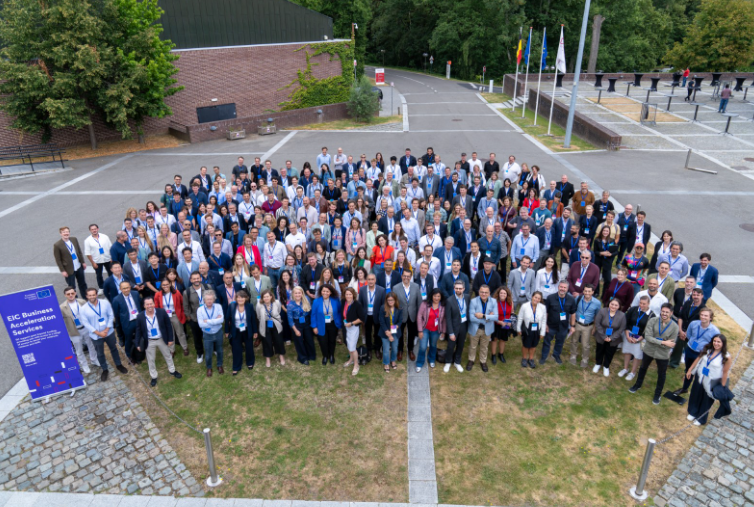
Most innovation conferences are designed to maximise attendance. The most effective ones are designed to maximise outcomes. That was the premise behind the second edition of The Impact Circle, held over three days in Boom and Brussels alongside Love Tomorrow. More than an innovation event, it was a carefully curated environment for corporate-startup collaboration, marking the 100th activity of the European Innovation Council’s Corporate Partnership Programme and one of the largest concentrations of corporate innovation teams assembled around a single matchmaking programme.
A milestone that reflects a broader shift
This year’s edition brought together more than 400 participants, including 12 hosting corporates, 20 observer companies and 79 selected startups across seven innovation circles. More than 100 one-to-one meetings were arranged before participants even arrived, complemented by workshops, executive roundtables and sector-specific discussions.
But this is only part of the story, and the real significance lay in the format. Instead of organising separate corporate programmes under one roof, The Impact Circle deliberately created overlap between industries, technologies and business challenges. A startup selected by one corporate frequently found opportunities with several others, while observer companies discovered businesses that had not originally been on their radar, and investors participated alongside innovation leaders rather than in parallel sessions. Scale became valuable because it was curated.
Beyond the pitch stage
The clearest evolution from previous editions was the growing importance of workshops. While startup pitches remain valuable for discovery, workshops revealed something more useful: how technologies might actually fit inside large organisations.
Across fifteen thematic sessions, discussions moved quickly beyond product demonstrations towards practical questions around procurement, implementation, manufacturing, regulation and organisational adoption.
Among the highlights, one discussion on scaling novel food ingredients brought together experts from Procter & Gamble, Cargill, Puratos, Melt&Marble and Brevel. Another explored how corporates can accelerate the adoption of artificial intelligence. On Thursday, The Coca-Cola Company, Procter & Gamble, Cargill and Galp jointly examined a common challenge: understanding customer behaviour and anticipating future demand, with fourteen startups presenting solutions relevant across multiple industries.
The discussion was organised around business problems rather than company presentations, and it shows that innovation succeeds when conversations begin with shared commercial challenges rather than with technology looking for an application.
A model for Europe’s next phase of innovation
European corporate innovation is entering a more mature phase. The emphasis is shifting away from discovering startups towards integrating them into business units capable of delivering measurable outcomes. That requires fewer random encounters and more carefully engineered interactions between the right organisations at the right time.
The Impact Circle 2026 demonstrated what that approach looks like in practice. By combining a record number of hosting corporates with curated matchmaking, thematic workshops and deliberate cross-pollination between industries, it showed that collaboration becomes significantly more valuable when designed as a system rather than as a sequence of isolated meetings.
The conversations that began in Boom and Brussels are now continuing through follow-up introductions, pilot discussions and commercial evaluations. Over the coming months, their success will not be measured by attendance figures, but by partnerships signed and projects launched.
The honest verdict on the week arrives next spring, in the form of pilots that survived their second budget cycle and contracts that reached a procurement system. This is why the work does not stop when the venue empties: we stay with those conversations through the months in which most of them would otherwise quietly lapse.
If you’re designing something similar and want to pressure-test the structure, reach out.