
As companies are laying out their long-term R&D plans, the European Commission is doing the same. Its next long-term budget is taking shape and with it the framework that will determine how European research and innovation is funded for the rest of the decade.
Every seven years, the EU resets its course. The current Horizon Europe programme (framework program 9, FP9) runs its final calls in 2027, and its successor, FP10, is already shaping up. For the EU, research and innovation funding is taking a bigger role in funding competitiveness. It gives an opportunity for forward looking companies to do the same: utilize EU funding opportunities as their competitiveness funding.
Below, we summarise what we know so far about FP10, what it means for companies exploring EU funding, and what remains of the current programme. For R&D and innovation leaders trying to make future-proof decisions today, these are the signals worth watching.
What we know about the new framework program and priority themes?
The next research and innovation programme, FP10, is set to run from 2028 to 2034 with a proposed budget of €175 billion. That is almost double the roughly €95 billion of the current Horizon Europe programme. Even adjusted for inflation, it is an increase of about 63%1.
More important than just the size is the direction. Collaborative research, the part of the programme where companies, universities and research organisations work together on joint projects, will be organised around four priority areas, each tied to a strategic EU objective:
- health, biotech, agriculture and bioeconomy
- clean transition and industrial decarbonisation
- resilience, security, defence and space
- digital leadership
This is where funding will be concentrated, and where companies with matching R&D portfolios can expect the most opportunities. Compared with today’s six thematic areas, three shifts stand out:
- Health and bio-based innovation converge. Health will share one cluster with biotech, agriculture and the bioeconomy. This may open more room for cross-sector projects in fields such as nutrition, biomanufacturing and healthy ageing.
- Culture and creativity lose their dedicated cluster.
- Security becomes a growth area. What is today civil security research widens into resilience, security, defence and space.
Given the geopolitical changes of recent years, the last shift is perhaps not surprising, but it is significant. Horizon Europe was designed to fund exclusively civil research. FP10 is set to support dual-use projects. Companies developing technologies such as AI, sensors, advanced materials or space systems may find defence and security budgets relevant to them for the first time.
The programme’s centre of gravity appears to be shifting slightly from solving global challenges through joint research towards strengthening Europe’s competitive position. Research remains the starting point, but it is increasingly expected to lead to products, markets and industrial capacity in Europe.
The bigger picture: the European Competitiveness Fund (ECF)
This emphasis on competitiveness reflects a broader rethink of EU funding, with the new Horizon Europe (FP10) forming part of a larger competitiveness package built around the new European Competitiveness Fund (ECF). The ECF is designed to strengthen the EU’s competitiveness in strategic technologies, while simplifying access to funding and mobilising private and public investment. The successor of Horizon Europe remains formally autonomous but sits financially within the ECF.
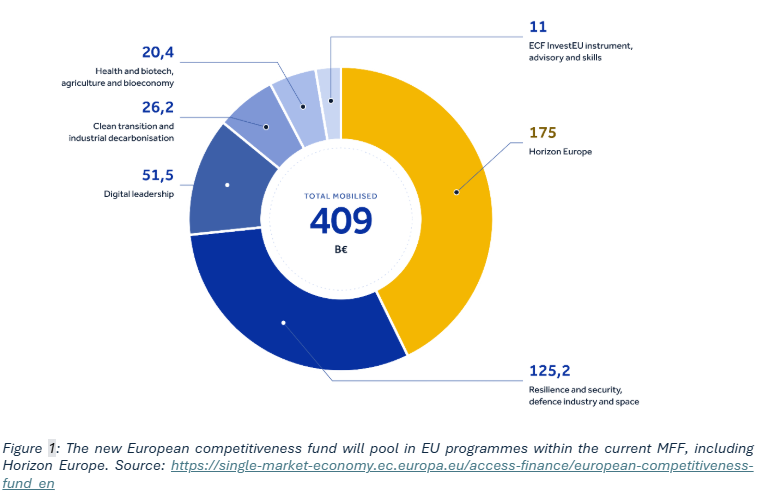
The ECF brings several existing EU programmes together under one rulebook, hopefully making funding simpler to navigate. It is organised around four strategic policy windows with the new Horizon Europe thematic research areas mirroring them. In practice, this means the same four themes should guide EU funding from early research through to scale-up and deployment.
What does this mean for R&D performing companies?
At Dealflow, we see these changes as largely positive for companies. A stronger focus on themes strategic to European resilience should create more opportunities for companies developing impactful R&D, across the whole innovation value chain.
Simpler access to funding options will benefit applicants, and the shift from research funding towards competitiveness funding may increasingly reward what large companies already do well: taking technologies to market, building value chains and investing at scale. As a result, large companies are likely to become even more sought-after partners in EU-funded projects.
What can we do now?
Taking a step back, the current funding window is not closed yet. The current Horizon Europe still has budget and hundreds of calls opening or about to open. The next wave of deadlines will be in February and April 2027, but September 2027 calls already worth taking a look as well.
The timing works in companies’ favour. In this second half of 2026, budgets and R&D priorities for 2027 are being set, and EU funding belongs in those discussions. Beyond the funding itself, EU projects connect companies with the partners, technologies and networks shaping their industries. That positions them at the forefront of emerging disruptions and strengthens their long-term leadership.
For seasoned participants in EU projects as well as for companies completely new to these opportunities, now is a good moment to start exploring. To encourage newcomers: 55% of Horizon Europe beneficiaries are newcomers to EU research programs2.
A good first step is GrantCompass, Dealflow’s free platform for finding open and upcoming calls and checking how well a company fits them. For a closer look at what the next years could mean for a specific R&D portfolio, our experts are happy to talk.